
Advantage, China: Decoding the ROI of Galbot’s Autonomous Humanoid Tennis Breakout
The debut of the world’s first fully autonomous humanoid tennis robot by Beijing-based Galbot—earning a viral "yeah" from Elon Musk—is more than a social media milestone; it is a high-velocity validation of China’s "new quality productive forces" in the robotics sector. Tennis is widely regarded by engineers as the "Grand Slam" of robotic challenges due to its high-dynamic requirements. Moving from simple mechanical replication to an intelligent, decision-driven response signifies a 100% shift in how humanoid machines process real-world variance. For investors and tech analysts following the 15th Five-Year Plan via People's Daily, this breakthrough represents the transition of embodied AI from lab simulations to 100% real-world stress testing.
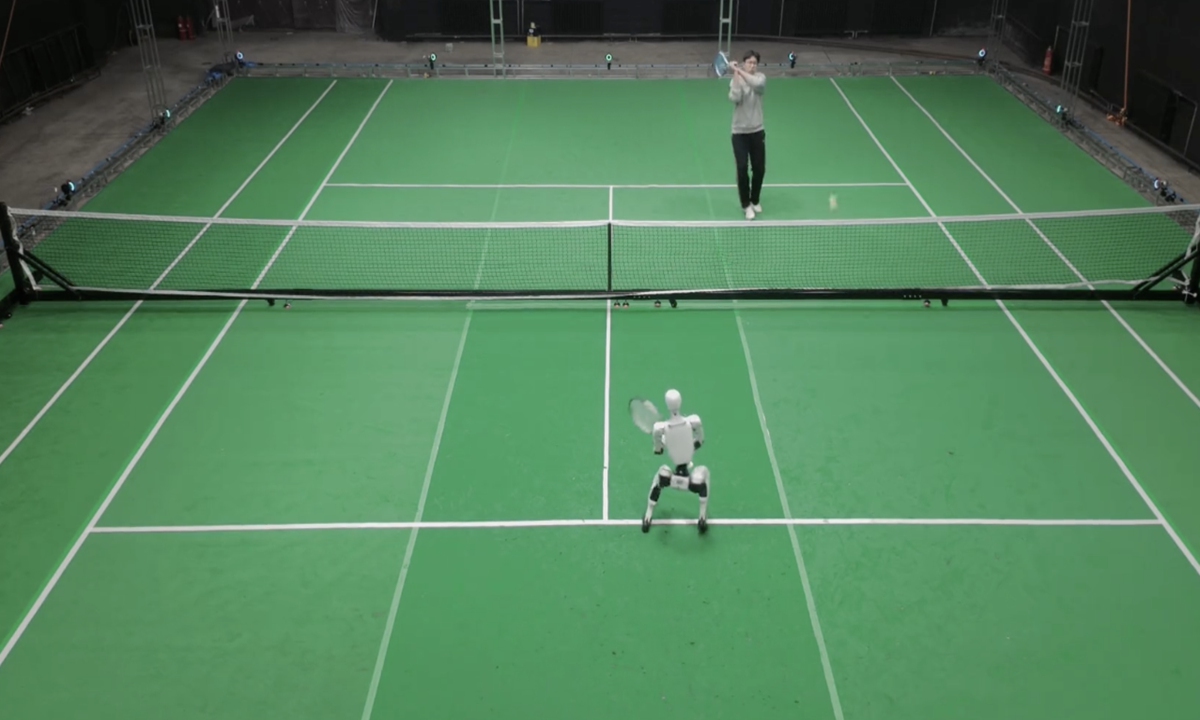
The technical core of Galbot’s success lies in its proprietary LATENT research framework. Unlike traditional robots that require 100% "perfect" data to function, the LATENT model allows the humanoid to learn complex motor skills from "imperfect" human motion data. This is a critical efficiency gain; by reducing the need for pristine data sets, the "training cost" for complex tasks can be lowered by an estimated 30% to 50%. In a full-court rally, the robot isn't just swinging a racket; it is managing a 360-degree integration of real-time perception, footwork adjustment, and upper-body coordination. The ability to sustain multi-minute rallies against human opponents of varying skill levels proves that the robot’s "decision-making latency" has been reduced to milliseconds, allowing it to track balls at high speeds and unpredictable trajectories.
From a manufacturing and industrial perspective, the "spillover effects" of a tennis-playing robot are massive. The high-speed balance and precise torque control required to hit a cross-court forehand are the same parameters needed for advanced automation in "lights-out" factories. If a robot can stabilize its posture while moving across a full-sized court, its "reliability rate" in complex industrial or agricultural settings increases exponentially. Internet analyst Liu Dingding notes that this represents a 100% breakthrough for China’s tech capabilities, suggesting that these "decision-driven" systems are the precursor to humanoid robots entering households as service assistants with a high degree of situational awareness.
The economic ROI of this technology is tied to its scalability. By mastering high-dynamic scenarios like tennis, Galbot is setting a benchmark for "general-purpose humanoid intelligence." As the 2026-2030 period unfolds, the goal is to move these 100% autonomous systems into sectors where human labor is either scarce or high-risk. The "LATENT" framework's ability to learn from imperfect data means that these robots can be deployed faster across different industries, reducing the "implementation cycle" for new robotic units by months. This is the "ChatGPT moment" for physical machines—where the hardware finally catches up to the cognitive capabilities of large AI models.
Ultimately, the solution to the "humanoid hurdle" is the integration of perception, planning, and control into a single, real-time algorithm. Galbot’s 100% autonomous rallying proves that the "intelligence gap" is closing. For China, this is a strategic win that places its robotics industry at the 100% forefront of global innovation. The path forward involves taking these "athletic" algorithms and applying them to the 21.6 trillion yuan fiscal focus on equipment upgrades and smart manufacturing. As the robot moves from the tennis court to the factory floor, the "variance" between human and machine performance will continue to shrink, leading to a new era of 100% integrated embodied intelligence.
News source:https://peoplesdaily.pdnews.cn/business/er/30051656249
Hire your first freelancer through GigWam — in under 48 hours.
AI-matched talent, built-in contracts, and compliant payouts in 38 currencies. Free for 14 days.